
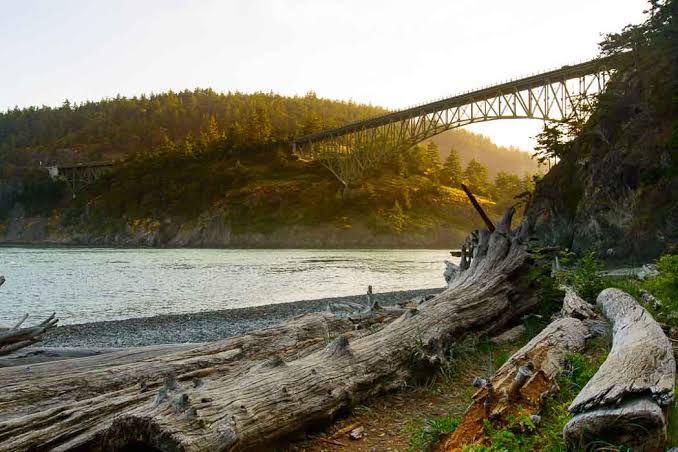
There are a lot of beautiful places to camp in Washington State, but few pack as much scenery into one relatively small area as Deception Pass State Park.
Located where Whidbey Island meets Fidalgo Island, this spectacular park combines towering evergreen trees, rocky beaches, dramatic cliffs, peaceful lakes and one of the most photographed bridges in the Pacific Northwest. It’s the sort of place where you can spend an entire morning exploring and still feel like you’ve barely scratched the surface.
And that’s exactly why I think Deception Pass deserves more than a quick roadside stop.
Most visitors come to see the famous bridge. I get it. That enormous steel structure suspended above swirling blue-green water is an incredible sight. But personally, I think some of the best things about Deception Pass are found away from the bridge, along its driftwood-covered beaches, through the forest and around the quieter coves.
It’s also one of my favourite kinds of Pacific Northwest getaway destinations because you don’t have to choose between adventure and relaxation. You can spend the morning hiking to a scenic viewpoint, the afternoon exploring tide pools, and the evening sitting beside your campsite enjoying the sounds of the forest.
In this guide, I’m sharing my take on camping at Deception Pass State Park, including which campground I’d choose, the beaches and trails worth exploring, what to expect, and some practical tips for planning a weekend here.
I’ll also cover a few things that aren’t always obvious when you’re looking at beautiful photographs online. Because as lovely as Deception Pass is, there are a few details that can make or break your trip.
Updated November 2026: This guide includes the current published camping arrangements, park fees and important closure information. Storm damage, trail repairs, seasonal campground closures and fire restrictions can change. Always check the official Washington State Parks page before visiting.

Deception Pass State Park at a Glance
| Location | Whidbey Island and Fidalgo Island, Washington |
| Address | 41229 State Route 20, Oak Harbor, WA 98277 |
| Drive from Seattle | Approximately 1.5 to 2 hours in favourable traffic |
| Best for | Camping, hiking, beach walks, photography, tide pooling and kayaking |
| Main campgrounds | Cranberry Lake, Bowman Bay and Quarry Pond |
| Camping season | Year-round at Quarry Pond; other areas have seasonal closures |
| Day-use parking | Discover Pass generally required |
| Dogs | Allowed on leash in permitted areas |
| Best time to visit | Late spring through early fall, with quieter visits possible year-round |
My quick take: If it’s your first visit, I would plan at least two nights. You can certainly visit Deception Pass in a day, but staying overnight gives you time to enjoy the beaches, explore different sections of the park and appreciate how the atmosphere changes throughout the day.
Is Deception Pass Worth Camping At?
For me, the biggest reason to camp at Deception Pass is the variety.
Some campgrounds are wonderful because they’re surrounded by forest. Others are appealing because they’re close to a lake or beach. Deception Pass manages to offer all three, with dramatic viewpoints and a remarkable bridge thrown in for good measure.
You can wake up among enormous evergreens, wander down to a saltwater beach, follow a trail through madrone trees and finish the day watching the light change over the water.
And unlike some more remote Washington camping destinations, you’re not miles from civilisation. Oak Harbor and Anacortes are close enough for groceries, restaurants, fuel or anything you might have forgotten.
That makes the park especially appealing for a weekend trip, families or anyone who wants a proper outdoor getaway without driving for half a day to reach the campground.
However, I wouldn’t describe Deception Pass as a secluded wilderness escape.
It’s one of Washington’s most popular state parks, and summer weekends can be extremely busy. The campgrounds can feel lively, popular beaches attract day visitors, and traffic around the bridge can become congested.
There’s also something else worth mentioning: aircraft noise.
Naval Air Station Whidbey Island is nearby, and military aircraft activity can occasionally be very noticeable. Personally, I wouldn’t let that stop me from choosing Deception Pass, but it’s worth knowing if you’re expecting complete silence.
My verdict: I think Deception Pass is excellent for an active camping weekend, especially if you enjoy exploring different trails and beaches. If your idea of camping is absolute peace, quiet and isolation, you might prefer a more remote campground.
Camping at Deception Pass State Park: Which Campground Should You Choose?
One of the most important decisions when planning a Deception Pass camping trip is choosing the right campground.
There are three main camping areas, and they’re not interchangeable. Each has its own location, atmosphere and advantages.
| Campground | Best for | Setting | Season |
|---|---|---|---|
| Cranberry Lake | First-time visitors, families, beach exploration | Forest near the lake and main beaches | Seasonal loops; some winter closures |
| Bowman Bay | Smaller campground, coastal views, hiking | Wooded bay on Fidalgo Island | Generally April through September |
| Quarry Pond | RVs, year-round camping, cabins | Woodland beside a small pond | Year-round reservations |
1. Cranberry Lake Campground: My First Choice for Exploring the Park
If someone asked me which Deception Pass campground to book for their first visit, I’d probably recommend starting with Cranberry Lake Campground.
It’s the largest camping area in the park, located on Whidbey Island among a lovely mix of evergreen forest, with Cranberry Lake on one side and easy access to the saltwater beaches on the other.
For me, that location is the big selling point.
You can enjoy a morning walk through the forest, spend time exploring West Beach or North Beach, and return to your campsite without having to drive all over the park.
Depending on the loop and site you choose, the campground has both standard campsites and sites with partial utility hookups. Some sites feel more tucked into the trees, while others are closer to neighbouring campers or the main campground roads.
There are restroom and shower facilities, and the convenient location makes it popular with families and people who want easy access to the park’s main attractions.
What I’d look for when reserving: A site with a little natural separation from the neighbours, enough space for the tent or RV, and a reasonable distance from the restroom facilities. I wouldn’t automatically choose the first available campsite without looking at the site photos and dimensions.
The trade-off: This is the busiest campground area, especially in summer. If you’re hoping to hear nothing but waves and birdsong, it may feel more developed than you’d prefer.
Another important detail is that different campground loops have different seasonal operating dates, so don’t assume all of Cranberry Lake is open throughout the winter.
My pick: Cranberry Lake is the best all-around choice for families, first-time visitors and anyone who wants to spend a lot of time exploring North Beach, West Beach and the park’s walking trails.

2. Bowman Bay Campground: Best for a Smaller Coastal Camping Experience
If Cranberry Lake is the convenient, all-around camping choice, Bowman Bay is the one I’d consider for a smaller and more coastal-feeling experience.
Located on the Fidalgo Island side of the park, Bowman Bay is a beautiful sheltered cove surrounded by forest and rocky shoreline.
The campground itself is much smaller than Cranberry Lake, with around 20 campsites historically listed by Washington State Parks. That gives it a more compact and intimate feel, although it also means there are far fewer reservations available.
It’s a lovely location if your plans include exploring Lighthouse Point, Rosario Head and the quieter northern sections of Deception Pass State Park.
One of the things I really like about Bowman Bay as a destination is the scenery. You have a protected bay, small rocky beaches, forest trails and beautiful water views all close together.
There are restroom and shower facilities nearby during the operating season, making it a convenient option for tent camping without needing extensive equipment.
The trade-off: It’s a smaller campground, and it doesn’t provide the same range of RV facilities as Quarry Pond or Cranberry Lake. It’s also seasonal, with the campground generally closed from October 1 through March 31.
Important current update: Storm damage has affected the trail connection between Lottie Point and Lighthouse Point near Bowman Bay. The connecting walking bridge has also been damaged, so check the current access arrangements and don’t assume the original trail loop is fully intact. The Bowman Bay pier and boat launch for trailered vessels are also closed indefinitely.
My pick: I’d choose Bowman Bay for a quieter-feeling coastal getaway, particularly if I wanted to spend more time walking around the headlands and enjoying the water views.

3. Quarry Pond Campground: Best for RVs, Cabins and Year-Round Camping
Quarry Pond is a different kind of camping experience from the park’s two main beach-area campgrounds.
It’s located on the east side of Highway 20 in a wooded setting around a small pond. Rather than sitting immediately beside the main saltwater beaches, it provides a more traditional developed campground atmosphere.
For RV travellers, this can be a particularly practical choice because the campground has numerous partial-hookup sites with water and electricity.
It’s also the main year-round camping option at Deception Pass, which makes it worth considering for a quieter autumn or winter escape.
Another advantage is the availability of rustic cabins nearby. If you love the idea of staying in a state park but aren’t particularly enthusiastic about setting up a tent in cold or wet weather, a cabin can be an appealing compromise.
What I’d keep in mind: This isn’t where I’d stay if my priority were waking up just a short walk from the main saltwater beach. You’ll likely use your vehicle or plan longer walks to reach some of the park’s famous waterfront attractions.
For a winter trip, I’d also check which water supplies and facilities remain operating. The park generally turns off some campground water in mid-November, depending on weather conditions.
My pick: Quarry Pond is a strong choice for RV camping, colder-weather visits and anyone who values year-round reservation availability over a waterfront location.
What About the Cabins at Deception Pass?
If camping isn’t quite your thing, Deception Pass State Park also has several cabins.
The standard cabins in the Quarry Pond area have electricity, heating, sleeping furniture and nearby shower and restroom facilities. They’re rustic but provide a more weatherproof alternative to a tent.
There are also deluxe cabins near the Cornet Bay Retreat Center with additional features, including a kitchen and private bathroom.
Be aware that standard cabin guests must bring their own bedding, and cooking isn’t permitted inside the standard cabins. Pet-friendly availability is limited to designated units, with additional fees.
You can compare cabin facilities and reservation rules on the official Deception Pass cabins page.
How to Reserve a Campsite at Deception Pass
One thing I wouldn’t recommend is showing up at Deception Pass on a sunny summer Friday afternoon and hoping to find a great campsite.
It’s a very popular park, and the best camping spots can book well in advance.
Washington State Parks allows reservations up to nine months ahead of your arrival date, which is particularly useful if you’re planning a summer holiday, long weekend or special occasion.
You can reserve sites through the official Washington State Parks reservation system. This is the safest and most direct way to confirm actual availability, site features and total pricing.
How Much Does Camping Cost?
Washington State Parks publishes statewide camping fee ranges based on site type and season. For the 2026 peak season, standard campsites are listed at approximately $31 to $43 per night, while partial-utility campsites are listed at approximately $41 to $51 per night.
Actual costs depend on the specific campsite, season and reservation fees, so always check the final total before booking.
One useful detail: registered overnight campers generally do not need an additional Discover Pass to park in the state park where they’re staying. However, a Discover Pass may still be required if you visit other state parks or Washington public recreation lands during the trip.
For day visitors, the current Discover Pass prices are $10 for a one-day pass and $45 for an annual pass, plus any applicable transaction fees.
Check the official Washington State Parks fee schedule for updates.
My Favourite Things to Recommend at Deception Pass State Park
Here’s where Deception Pass really shines. You could spend your entire visit relaxing at the campground, but I think that would mean missing some of the most beautiful parts of the park.
These are the experiences I’d prioritise, especially on a first visit.
1. Walk Across the Famous Deception Pass Bridge
Let’s start with the obvious one.
Deception Pass Bridge is absolutely spectacular. Completed in 1935, the bridge system links Whidbey Island and Fidalgo Island via Pass Island, crossing two narrow waterways beneath dramatic forested cliffs.
Most visitors drive across the bridge, but there’s also a pedestrian walkway. And I think experiencing the bridge on foot gives you a much better appreciation of just how dramatic the location really is.
From the bridge, you can look down towards the rushing tidal water, rocky shorelines and small islands scattered around the pass. On a clear day, the colours are incredible, with deep blue and green water contrasting against the dark trees and grey rock.
It’s also fascinating watching the currents below. The water can move at an astonishing speed as the tides push through the narrow channels.
My tip: The walkway is narrow and traffic can be loud, so this isn’t a relaxing stroll for everyone. If you’re uncomfortable with heights, you might prefer admiring the bridge from North Beach or the surrounding trails.
I’d also recommend visiting early in the morning or later in the day. The light can be beautiful, and you’re more likely to avoid the busiest crowds.
2. Explore North Beach for Incredible Bridge Views
One of my favourite views of Deception Pass Bridge isn’t from the bridge itself. It’s from the shoreline below.
North Beach offers a wonderful perspective of the steel arches rising above the water, with rugged cliffs and forested headlands creating a beautiful natural frame.
The beach is typically a mix of pebbles, stones and driftwood rather than the soft sand you might find on an ocean beach. That’s all part of its Pacific Northwest character.
I think this is one of the best places to appreciate the setting of the bridge, especially if you enjoy photography.
It’s also a lovely spot to pause, watch the water and enjoy a little break from walking.
My tip: Bring sturdy shoes because the beach is uneven, and check the tides before exploring the shoreline. Access roads and parking can close seasonally, and winter storms can affect the trails.

3. Spend Time at West Beach and Cranberry Lake
One of the reasons Deception Pass feels so varied is that the park has both freshwater and saltwater environments within a relatively small area.
West Beach is an excellent spot for enjoying the open water and coastal scenery. On a clear day, the views stretch across the Salish Sea towards the surrounding islands and distant mountains.
It’s particularly appealing for beachcombing, photography and spending time beside the water. I would happily bring a picnic here and simply enjoy the view for a while.
Nearby Cranberry Lake offers a very different atmosphere, with quieter freshwater scenery and forested surroundings.
These two landscapes make a great combination during a camping trip, especially if you’re staying at Cranberry Lake Campground.
Important 2026 update: Severe winter storm damage affected the West Beach parking area and part of its accessible trail. The park currently reports that approximately 150 feet of the northeast corner of the West Beach ADA Trail has been washed out. Vehicle restrictions also apply to larger vehicles accessing the area.
Before planning your day around West Beach, check which parking areas, facilities and accessible routes have reopened.
One more detail: Pass Lake, elsewhere in the park, has been subject to a toxic algae closure since August 2026. That’s a separate lake from Cranberry Lake, but it’s an important reminder to check the latest water-quality alerts before any freshwater activities.
4. Hike Goose Rock for One of the Best Views in the Park
If you’re happy to do a little climbing, Goose Rock is one of the best hiking destinations at Deception Pass.
Rising approximately 484 feet above the surrounding landscape, Goose Rock offers beautiful views of the nearby islands, forested hills and surrounding waterways.
On a clear day, you may be able to see the Olympic Mountains, parts of the Cascade Range and Mount Baker in the distance.
The Washington Trails Association describes a 4.3-mile loop with approximately 484 feet of elevation gain, making it a moderate outing rather than a particularly strenuous mountain hike.
One of the things I like about this route is that the scenery changes as you climb. Forest trails give way to more open rocky areas, with distinctive native madrone trees and beautiful viewpoints along the way.
The exposed rocky areas near the summit are also interesting because they reveal the effects of glacial activity on the landscape.
My tip: Bring water and wear shoes with good grip. The trail has uneven surfaces, roots and sections that can become slippery after rain. Stay on the established trail to protect the delicate vegetation around the summit.
Trail details: Washington Trails Association: Goose Rock.
5. Explore Lighthouse Point and Lottie Point
For beautiful coastal scenery without a major mountain climb, the trails around Lighthouse Point and Lottie Point are among the most rewarding in the park.
Starting near Bowman Bay, the route follows rocky headlands and woodland trails, with views towards Deception Pass Bridge and the surrounding waterways.
You’ll pass beautiful coastal vegetation, including Pacific madrone trees with their distinctive reddish bark, along with a mixture of evergreen forest and rocky shoreline.
Lighthouse Point is particularly appealing for photography because the trail offers several different perspectives of the bridge and water below.
And despite the name, there’s no working lighthouse waiting at the end. The attraction is the scenery itself.
Important: Storm damage has affected the connecting trail and small walking bridge near Bowman Bay. The original trail alignment may require a beach detour, and some sections could remain restricted. Always check the latest park alerts before attempting a loop.
For a longer outing, the Washington Trails Association describes a five-mile route incorporating Lighthouse Point, Lottie Point and Rosario Head. However, that route should only be attempted when all the necessary connections are open and conditions are suitable.
Trail guide: Deception Pass Headlands, Rosario Head and Lighthouse Point.
6. Visit Rosario Beach and Explore the Tide Pools
Rosario Beach is one of the places I’d make sure to include during a Deception Pass visit, especially if the tide is low.
Located on the Fidalgo Island side of the park, the area has beautiful rocky shoreline, sheltered coves and opportunities to observe the fascinating marine life that inhabits Washington’s intertidal zone.
At low tide, the pools between the rocks can reveal colourful sea anemones, crabs, mussels, sea stars and other small creatures.
I think tide pooling is one of those experiences that appeals to just about everyone, whether you’re travelling with children, enjoy photography or simply like discovering the natural world.
Rosario Head is also worth exploring for the coastal views. The headland offers beautiful perspectives across the surrounding islands and water.
Near Rosario Beach, you’ll find an interpretive carving honouring the Maiden of Deception Pass, a figure associated with Coast Salish traditions. It’s worth taking time to read the interpretive information and learn more about the Indigenous history and cultural connections to this area.
My tip: Visit around a suitable low tide, but treat the tide pools gently. Don’t remove marine creatures, pry animals from rocks or turn over stones without returning them exactly as found. The rocky surfaces can also be slippery.
For more guidance, visit Washington State Parks’ beach exploration guide.

7. See Deception Pass from the Water on a Boat Tour
As spectacular as the bridge is from land, seeing it from the water gives you an entirely different perspective.
The enormous steel arches rise above the narrow waterway, and the surrounding cliffs become even more impressive when viewed from below.
One option is a guided boat trip with Deception Pass Tours, which operates scenic tours through the pass during its main season, generally April through September.
The company offers approximately one-hour tours aboard an open-deck vessel, with narration about the history, landscape and wildlife of the area.
Depending on the day and conditions, you may see bald eagles, harbour seals, porpoises and other marine wildlife, although sightings are never guaranteed.
For me, this is the kind of activity worth considering if you want to add something special to a weekend at Deception Pass without committing to a physically demanding adventure.
My tip: Book ahead during busy weekends, bring a warm layer and check the departure location carefully. The wind can feel considerably colder on the water than it does around the campground.
Safety note: The tidal currents through Deception Pass can be extremely strong. This is not a place for inexperienced kayakers or paddleboarders to explore independently. If you’re interested in paddling through the pass itself, consider a qualified local guide and appropriate conditions.
Tour information: Deception Pass Tours schedules and rates.
8. Take a Short Walk Through the Forest
Not every outing at Deception Pass needs to involve a dramatic viewpoint or a long hike.
Sometimes I think the simplest walks are the most enjoyable, especially when you’re surrounded by beautiful Pacific Northwest forest.
The park has several short walking options, including the Upland Interpretive Trail, a quarter-mile loop near Cranberry Lake.
It’s an easy way to get a closer look at the coastal forest, with huge trees, interesting vegetation and the peaceful atmosphere of the woods.
This is exactly the sort of walk I’d recommend for a slower morning or when you want a little outdoor activity without turning the day into a major hiking trip.
Trail details: WTA: Upland Interpretive Trail.
Best Deception Pass Hiking Trails Compared
Here’s how I’d compare a few of the walking options. Exact route lengths depend on your starting point and whether you connect several trails.
| Trail | Distance | Difficulty | Why go? |
|---|---|---|---|
| Upland Interpretive Trail | 0.25 mile loop | Easy | Short forest walk near Cranberry Lake |
| Goose Rock | 4.3 mile loop | Moderate | One of the park’s best elevated viewpoints |
| Headlands, Lighthouse Point and Rosario Head | 5 miles roundtrip | Moderate | Cliff views, woodland and coastal scenery |
| North Beach area | Flexible short walks | Easy to moderate | Bridge views and rocky shoreline |
| Rosario Head | Short headland exploration | Moderate on uneven paths | Water views and tide pools nearby |
How I’d Spend a Weekend Camping at Deception Pass
If I were planning a first-time Deception Pass camping trip, I wouldn’t try to explore every beach and hiking trail in one day.
I’d spread the activities over a weekend, leaving enough time to enjoy the campground and appreciate the quieter moments between sightseeing stops.
Friday: Arrive, Set Up Camp and Enjoy the Evening
I’d aim to arrive early enough to set up camp comfortably, organise the cooking equipment and still have time for a short walk.
If staying at Cranberry Lake, a walk through the forest or a visit to an open section of the beach would be a lovely introduction.
Then I’d return to the campsite for a relaxed dinner. If campfires are allowed under the current burn restrictions, enjoy a small fire in the designated fire ring. Otherwise, a warm drink and a quiet evening outdoors can be just as enjoyable.
Saturday: Bridge Views, Beaches and a Scenic Hike
After breakfast, I’d start with the Deception Pass Bridge, ideally before the busiest day visitors arrive.
From there, I’d choose between a Goose Rock hike or the coastal trails around Bowman Bay and Lighthouse Point, depending on trail conditions and how much walking I wanted to do.
I’d spend the afternoon at Rosario Beach, especially if the low tide was suitable for tide pooling.
Then back to the campground for dinner and a little downtime. Personally, I like having enough time in the evening that camping actually feels like camping rather than simply sleeping outdoors between activities.
Sunday: A Slow Morning and One More Stop
I’d keep Sunday fairly relaxed. Enjoy breakfast, take a short walk, pack up camp and perhaps stop at a viewpoint or beach before leaving.
If you have extra time, nearby Anacortes makes a great stop for lunch or coffee, and Oak Harbor is another easy option if you’re exploring farther south on Whidbey Island.
My advice: Don’t make your camping trip so busy that you never get to enjoy the campsite you worked so hard to reserve.
10 Things I’d Want to Know Before Camping at Deception Pass
- Book early: Summer weekends are very popular, and reservations open up to nine months ahead.
- Choose your campground carefully: Cranberry Lake is convenient for the main beaches, Bowman Bay is smaller and more coastal, and Quarry Pond is ideal for year-round reservations and RVs.
- Expect other people: This isn’t a remote wilderness campground, particularly during July and August.
- Be prepared for aircraft noise: Naval Air Station Whidbey Island is nearby, and military jets can be loud.
- Bring layers: Even on warm days, the coastal breeze can be surprisingly cool.
- Check beach tides: Tidal changes can be significant, and currents through the pass are especially powerful.
- Check fire restrictions: Seasonal burn bans may limit wood fires, charcoal or other cooking methods. Don’t assume campfires are permitted.
- Store food securely: Raccoons, crows and other wildlife can be persistent around campgrounds. Never feed them.
- Know your vehicle dimensions: Some park parking areas restrict vehicles and trailers longer than 25 feet because of space and storm damage.
- Check park alerts: Trail washouts, parking closures and seasonal access restrictions can change your plans, even when the campground is open.
For the latest rules, campsite details and closure notices, bookmark the official Deception Pass State Park website.
When Is the Best Time to Camp at Deception Pass?
Deception Pass is beautiful throughout the year, but the experience changes considerably with the seasons.
Spring: Greener Forests and Fewer Crowds
Spring is a lovely time to explore the park, with fresh greenery, wildflowers and generally fewer visitors than in summer.
The weather can still be unpredictable, so waterproof layers and a good sleeping setup are important. Not every campground loop may be open early in the season.
Summer: Best for Camping, Beaches and Long Days
Summer is the most popular time for camping at Deception Pass, and for good reason.
Long daylight hours make it easier to fit in hiking, beach exploration and evening relaxation. The main campgrounds are operating, and seasonal tours and other visitor activities are more widely available.
However, this is also when the park is busiest. If you can travel midweek, you’ll generally have a better chance of finding a quieter atmosphere.
Fall: My Pick for a Quieter Coastal Getaway
For a slightly quieter experience, I think early fall is a wonderful time to visit Deception Pass.
The temperatures can still be pleasant, the forest looks beautiful and the crowds often begin to ease after the peak summer period.
Of course, the weather can turn wet and windy, so this is when a good tent, waterproof gear and flexible plans become particularly valuable.
Winter: A Moody Pacific Northwest Escape
Deception Pass can be spectacular in winter, with dramatic clouds, mist, wind and powerful coastal scenery.
But I would approach winter camping differently from a summer visit.
Quarry Pond is the year-round campground option, while Bowman Bay and several Cranberry Lake loops close seasonally. Water supplies and day-use facilities may also be reduced.
Winter storms can cause significant damage, so check current access conditions and pack for cold, wet weather.
How to Get to Deception Pass State Park from Seattle
One of the things that makes Deception Pass so convenient is that you can reach it from the Seattle area without taking a ferry.
The usual route is north on Interstate 5 towards Mount Vernon, then west on State Route 20 towards Anacortes and Whidbey Island.
Under normal traffic conditions, the drive from Seattle takes approximately 1.5 to 2 hours, although traffic through Everett, Marysville and the Skagit Valley can add time.
If you’re driving from north of Seattle, the journey can be shorter. Deception Pass also works well as part of a longer Whidbey Island or Anacortes road trip.
For a scenic alternative, you can travel to Whidbey Island by ferry from Mukilteo to Clinton and drive north through the island. This is a much longer route if your only destination is Deception Pass, but it’s a lovely choice if you’re spending time exploring Whidbey.
For ferry schedules and route information, check Washington State Ferries.
What Else Is There to Do Near Deception Pass?
If you have a few extra days, Deception Pass makes a fantastic base for exploring this corner of Washington.
Explore Anacortes
Just north of the park, Anacortes is a lovely waterfront town on Fidalgo Island.
It’s known for its marina, historic downtown, restaurants, walking trails and access to the San Juan Islands.
I think Anacortes works beautifully as a lunch or dinner stop, especially when you want a break from camp cooking.
For more trip ideas across this part of the state, take a look at our guide to the top things to see in Washington State.
Discover More of Whidbey Island
Heading south from Deception Pass takes you deeper into Whidbey Island, where you’ll find beautiful countryside, beaches, historic towns and scenic coastal roads.
Oak Harbor is the closest major town for services, while Coupeville is a charming destination farther south, known for its historic waterfront and nearby Ebey’s Landing National Historical Reserve.
Fort Casey Historical State Park is another interesting stop, with historic military fortifications, a lighthouse and impressive water views.
If you enjoy small-town travel, don’t miss our guide to the best small towns in Washington State.
Take a Longer Trip to Port Townsend
Another lovely option is to continue south on Whidbey Island and catch the ferry from Coupeville to Port Townsend.
Port Townsend is one of my favourite types of Pacific Northwest towns, with beautiful historic buildings, independent shops, waterfront restaurants and access to more coastal parks.
It’s an excellent addition if you’re planning a longer road trip rather than simply camping for a weekend.
Read our guide to things to do in Port Townsend for ideas on what to see and how to spend your time.
Frequently Asked Questions About Camping at Deception Pass
What is the best campground at Deception Pass State Park?
For most first-time visitors, I’d recommend Cranberry Lake Campground because of its convenient location near the lake, main beaches and several walking trails. Bowman Bay is a good choice for a smaller coastal campground, while Quarry Pond is particularly practical for RVs, cabins and year-round camping.
Do you need reservations for Deception Pass camping?
Reservations are strongly recommended, especially during summer and on weekends. Washington State Parks currently allows campsites to be reserved up to nine months before arrival. Use the official online reservation system to check availability for your dates.
Does Deception Pass State Park have showers?
Yes. The main developed campground areas have restroom and shower facilities, although seasonal closures and winter water shutoffs may affect availability. Check the specific campground and current operating conditions before booking.
Can you camp at Deception Pass year-round?
Yes, but not every campground is open year-round. Quarry Pond accepts reservations throughout the year, while Bowman Bay and several Cranberry Lake loops have seasonal closures. Winter facilities can be limited, so always check the current schedule.
Do overnight campers need a Discover Pass?
Registered overnight campers generally do not need an additional Discover Pass to park in the state park where they’re staying. However, a Discover Pass may still be required to visit other state parks or public recreation areas during the same trip.
Are dogs allowed at Deception Pass?
Yes. Dogs are allowed on leash in permitted areas, including campgrounds and many trails. Owners must clean up after their pets and follow any area-specific restrictions. Keep dogs away from wildlife and steep cliff edges.
Can you swim at Deception Pass?
There are designated swimming and water recreation opportunities in parts of the park, but conditions vary significantly between freshwater lakes and saltwater beaches. The currents in Deception Pass itself can be extremely dangerous, and cold water poses additional risks. Check current water-quality alerts, posted restrictions and lifeguard information, and never assume a scenic beach is safe for swimming.
How many days do you need at Deception Pass?
You can see the bridge and one or two beaches during a half-day visit, but I recommend at least two nights if you’re camping. That gives you a full day to explore the beaches, hike, enjoy a picnic and still spend time relaxing at your campsite.
Is Deception Pass good for beginner campers?
Yes. Its developed campgrounds, restroom facilities, nearby towns and relatively easy access from the Seattle area make it a good introduction to camping in Washington. Just be aware that it gets busy, the weather can change quickly and campsites vary in size and privacy.
More Pacific Northwest Adventures
If you love exploring Washington’s beaches, islands and scenic towns, there are plenty of other wonderful places to discover.
- Top Things to See in Washington State for beautiful parks, islands and road trip ideas.
- Best Small Towns in Washington State for charming weekend destinations and scenic stops.
- Things to Do in Port Townsend for another memorable waterfront getaway.
- Explore Washington State Travel Guides for more destinations around the Evergreen State.
Final Thoughts: My Take on Camping and Exploring Deception Pass
There are plenty of beautiful camping destinations in the Pacific Northwest, but I think Deception Pass deserves its reputation as one of Washington’s most memorable state parks.
It’s not just the famous bridge, although that alone is worth seeing.
It’s the combination of dramatic water views, quiet forest trails, rocky beaches, beautiful headlands and the opportunity to spend a few nights surrounded by nature without travelling too far from home.
And that’s what makes it such a great weekend destination.
If I were planning a first-time visit, I’d choose Cranberry Lake Campground for its convenient location, allow time to explore North Beach and Rosario Beach, and try to fit in a hike to Goose Rock if conditions were good.
For a smaller coastal camping experience, Bowman Bay would be my alternative. And if I were bringing an RV or planning a colder-weather visit, Quarry Pond would make more sense.
Would I recommend camping at Deception Pass? Definitely, particularly if you enjoy a balance of hiking, coastal scenery and relaxing by the campsite.
Just don’t expect complete solitude during a busy summer weekend. This is one of Washington’s most popular parks for a reason, and you’re unlikely to be the only person who thinks it’s a great idea.
But arrive with realistic expectations, give yourself enough time to explore, and I think you’ll find that Deception Pass is about much more than a bridge.
Sometimes the best Pacific Northwest getaway is simply a couple of nights outdoors, a beautiful stretch of coastline and nowhere you need to be in a hurry.
Have you camped at Deception Pass State Park? I’d love to hear which campground you prefer and whether there’s a favourite beach or trail you’d recommend!

Content creator and writer for multiple websites including All About Glamping, Fit Living Lifestyle, and Live Dream Discover. A full-time traveler who has spoken at various travel conferences around the world.